
New Relic Alternative for Bootstrapped Startups
New Relic alternative for bootstrapped startups. Distributed tracing and dynamic logs starting at $29/month instead of $500+. 5-minute setup.

Bootstrapped startups often struggle to find affordable observability tools. Platforms like New Relic and Datadog can cost $500+ per month, with expenses escalating as teams grow. This forces small teams into cost-cutting strategies that hinder scalability. A better option? TraceKit - a cost-effective alternative with request-based pricing starting at $29/month. It offers:
- Affordable pricing: $29/month for 1 million traces, or a free tier with 200,000 traces.
- Quick setup: Under 5 minutes to install and start monitoring.
- Efficient debugging: Tools like Dynamic Logs in Production eliminate redeployments.
- Scalability: Unlimited team members and no "host tax."
Quick Comparison:
| Platform | Pricing Model | Setup Time | Debugging Features | Scalability for Startups |
|---|---|---|---|---|
| TraceKit | Request-based ($29) | < 5 minutes | Dynamic Logs in Production | Unlimited team members |
| New Relic | User-based ($99–$549/user) | 2–4 weeks | NRQL, AI features (extra cost) | User limits on free/low tiers |
| Datadog | Host-based ($31/host) | 2–4 weeks | Correlates traces, logs, metrics | Costs rise with scaling |
TraceKit delivers cost savings (up to 80%), fast setup, and real-time debugging tools, making it ideal for startups on a budget.
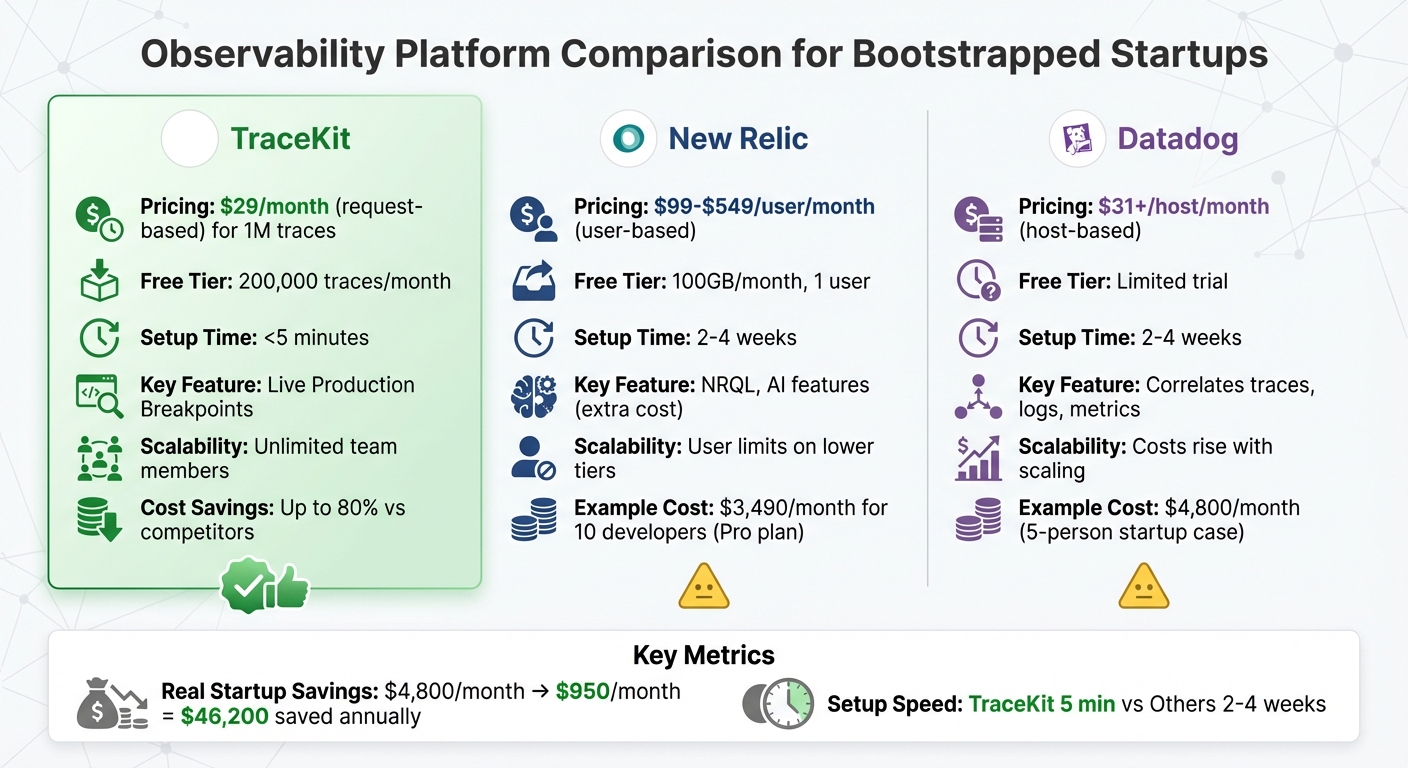
TraceKit vs New Relic vs Datadog: Pricing and Features Comparison for Startups
1. TraceKit
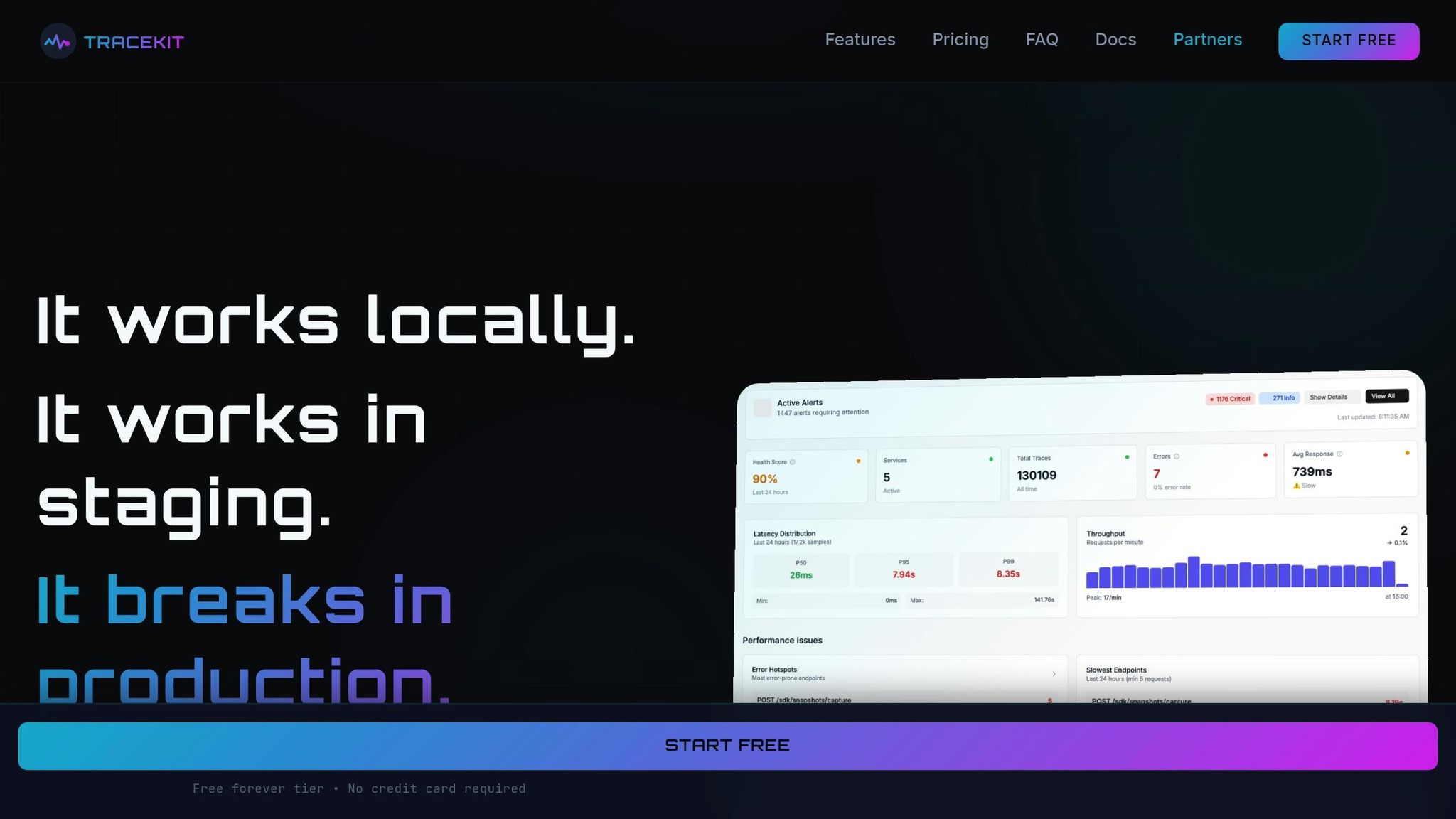
Pricing
TraceKit takes a different approach to pricing by charging based on requests rather than per host or user. The Starter plan is $29 per month and includes 1 million traces with a 30-day retention period. For those just starting out - like indie developers or students with no revenue - there’s a "Free Forever" tier. This plan provides 200,000 traces per month, 7-day retention, and advanced features such as dynamic logs in production and anomaly detection.
One startup managed to cut its monthly expenses from $4,800 to just $950 by switching to TraceKit's Growth plan, which costs $99 per month for 10 million traces. That’s an 80% reduction, saving them $46,200 annually [1][4]. This pricing model, paired with its quick setup process, makes TraceKit a cost-effective choice for developers.
Setup Time
TraceKit boasts a setup process that takes under 5 minutes - far quicker than the 2–4 weeks often required by traditional APM tools. Installation is straightforward, requiring just a single command via Homebrew or curl. The system automatically detects frameworks and configures API keys, completing instrumentation in less than 4 minutes. Plus, it adds less than 5% performance overhead [4][5]. This rapid deployment ensures you can start debugging almost immediately.
"I built Tracekit as an affordable alternative starting at $29/month with runtime inspection." - Terry Osayawe, Founder of TraceKit [2]
Features for Debugging
Once up and running, TraceKit offers powerful real-time debugging tools that streamline the troubleshooting process. One standout feature is its Dynamic Logs in Production (also called "capture points"), which let developers inspect variables and application paths in real time - no need to redeploy code. For example, in early 2026, a solo SaaS founder named Alex used a capture point to pinpoint a race condition in a Stripe webhook. What would have taken two days of manual logging and redeployments was resolved in just 10 minutes.
Another key feature is the Request Lifecycle Replay. This tool visualizes requests as sequence diagrams, showing the order, duration, and failure points of service calls. On top of that, TraceKit’s AI-powered insights flag performance bottlenecks, such as N+1 queries or sluggish external APIs, saving developers even more time [4][5].
"TraceKit helped me find performance issues before I released the new version of my framework. I was able to fine-tune everything and fix problems before they hit users." - Ali Khorsandfard, Creator of Gemvc PHP Framework [4]
Scalability for Small Teams
TraceKit isn’t just affordable and fast - it’s designed to grow alongside your team. Its request-based pricing solves the "Host Tetris" problem, meaning adding more hosts won’t inflate your costs. All paid plans include unlimited team members, so you can expand your team without worrying about extra fees.
The platform supports multiple programming languages, including Go, PHP, Node.js, Python, Java, and Ruby. Built on OpenTelemetry standards, it ensures you’re not locked into a single vendor [4]. This flexibility makes TraceKit a smart choice for startups looking for robust observability tools without the hefty price tag of enterprise solutions.
2. New Relic
Pricing
New Relic's pricing structure can quickly become a financial burden for bootstrapped startups. The free tier offers 100 GB of data ingest and one Full Platform User. However, costs escalate with the Standard plan at $99 per user per month (up to 5 users), the Pro plan at $349 per user per month (with an annual commitment), and the Enterprise plan reaching $549 per user per month. On top of that, exceeding the 100 GB data limit incurs charges of $0.40–$0.60 per GB.
This "seat tax" pricing model makes collaboration more expensive as teams grow.
"Observability is a team sport, until the bill arrives" - Aditya Somani, ClickHouse [7]
For example, a team of 10 developers on the Pro plan would pay $3,490 per month before factoring in additional data costs. At scale, user seats alone can account for up to 66% of the total observability bill [6]. This pricing model, combined with implementation challenges, poses hurdles for small, budget-conscious startups.
Setup Time
Deploying New Relic isn't a quick process. It typically takes 2–4 weeks to fully implement [5]. With over 30 observability tools and 780+ integrations, the platform demands significant time and effort to learn - an added strain on small teams already juggling multiple priorities [6].
Features for Debugging
New Relic offers a wide range of tools, but its debugging capabilities aren't streamlined for quick problem-solving. The platform relies on its proprietary New Relic Query Language (NRQL) and agent-based data collection, which can lead to vendor lock-in. This setup often slows down root cause analysis, potentially delaying issue resolution [5][7].
Additionally, New Relic's AI-powered features, like predictive alerting and AI-assisted root cause analysis, are billed through Advanced Compute Units (aCCUs). This billing method introduces extra complexity and costs, which may not align with the priorities of a resource-constrained startup [7].
Scalability for Small Teams
New Relic's per-user pricing model creates challenges for growing teams. For instance, the Standard plan limits access to just 5 Full Platform Users, forcing teams to upgrade to the Pro or Enterprise tiers to accommodate more users. This makes it harder to provide observability access to the entire team without significantly increasing expenses [7]. In contrast, startups often prefer simpler, request-based pricing models that better align with their need for cost efficiency as they scale.
3. Datadog
Pricing
Datadog charges $31 per host per month for APM, with extra fees for logs and custom metrics. For small teams, these costs can pile up fast. The platform calculates bills based on the peak monthly usage, meaning you're charged for the highest resource consumption during the month. This host-based pricing model can be a challenge for teams using containers, as costs rise with horizontal scaling. In comparison, TraceKit uses a request-based model that adjusts with actual traffic, offering a more flexible approach. On top of this, Datadog's setup process is lengthy, adding to the overall expense.
Setup Time
Getting Datadog fully implemented can take anywhere from 2 to 4 weeks. It also comes with a steep learning curve, and its interface is better suited for large enterprise teams rather than smaller groups of 1–5 developers [5][9]. On the other hand, TraceKit simplifies things with a one-command installation, allowing teams to start monitoring in under a minute. This eliminates the need for a multi-week onboarding process, saving valuable time.
Features for Debugging
Datadog shines when it comes to correlating traces, metrics, and logs in one interface. Developers can jump from a slow trace to related host metrics or error logs, and the platform includes real user monitoring with session replay. However, it relies heavily on pre-configured logging, meaning you need the right logs in place before an issue occurs.
TraceKit takes a different approach with Dynamic Logs in Production, letting developers examine variable states and request payloads at specific lines of code without needing to redeploy. This eliminates the repetitive log-and-redeploy cycle.
"I spent two days adding logs, redeploying, waiting. Every time I thought I had it, I'd realize I needed to log something else. I was losing subscriptions." - Ali Khorsandfard, Creator of Gemvc [8]
For small teams, this streamlined debugging process can save significant time and effort, especially when compared to Datadog's more traditional methods.
Scalability for Small Teams
Datadog's host-based pricing introduces what some call a "host tax", where costs increase linearly as you add more containers or microservices. At $31 or more per host each month, this model can push teams to design their infrastructure around cost limitations instead of focusing on performance.
"Datadog's pricing can be prohibitively expensive, especially for growing organizations. The per-host pricing model quickly adds up as your infrastructure scales..." - Alexandr Bandurchin of Uptrace [11]
In contrast, TraceKit's request-based pricing offers a more scalable and predictable option for small teams, allowing them to grow without being weighed down by escalating costs.
Datadog vs New Relic (2025) – Which Monitoring Tool Is Smarter?
Pros and Cons
For startups aiming to achieve effective observability without breaking the bank, comparing platforms is a key step. ****
[5]
[3]****
[10][12]
[10][12]****
| Platform | Strengths | Weaknesses |
|---|---|---|
| TraceKit | • Request-based pricing starts at $29/month, offering predictable costs | • Quick 5-minute setup with a single-command installation |
| New Relic | • Generous free tier with 100GB/month and one full-platform user | • Comprehensive observability and strong APM support across multiple languages |
| Datadog | • Extensive integration options (over 600) | • Excels at correlating traces, metrics, and logs |
The table highlights some key takeaways: TraceKit’s request-based pricing model avoids the high costs often associated with host-based or per-user pricing structures. Its dynamic logs in production also simplify debugging by eliminating the need for constant log reviews and redeployments, making it an appealing choice for smaller teams.
"Great tools shouldn't cost six figures. We price for startups, scale-ups, and enterprises alike." - TraceKit.Dev [5]
Conclusion
Selecting the right observability platform is all about aligning your needs with a tool’s pricing structure and complexity. For solo developers or pre-revenue startups, TraceKit stands out with its free tier, offering 200,000 traces per month without requiring a credit card. This makes it an ideal starting point. As your startup begins generating revenue, the $29/month starter plan ensures predictable costs, even as you scale with containers or serverless functions.
Other platforms, like New Relic and Datadog, come with their own advantages and trade-offs. New Relic provides a generous free tier - 100GB/month - that works well for small teams of fewer than five users. However, its user-based pricing can quickly escalate as your team grows. Similarly, Datadog offers powerful infrastructure monitoring but relies on host-based pricing, starting at $31 per host per month for APM, which can strain smaller budgets.
For bootstrapped startups focused on speed and cost efficiency, TraceKit offers a streamlined setup process, avoiding the lengthy configurations typical of enterprise tools. Features like dynamic logs in production allow real-time variable inspection without redeployment, saving valuable engineering time. By adopting TraceKit’s request-based pricing model, startups can slash costs by up to 80% while maintaining comprehensive observability.
Though some teams may explore other usage-based platforms like SigNoz or Uptrace, TraceKit continues to offer the best mix of affordability and features for startups. While New Relic and Datadog cater to more complex needs, their pricing structures can be difficult to manage, making TraceKit a smarter choice for startups looking to grow efficiently.
FAQs
How many traces do I need each month?
With TraceKit's free plan, you can monitor up to 200,000 traces per month without spending a dime. For teams needing more capacity, the Starter plan is available at just $29 per month, offering extra room to grow. TraceKit provides options designed to match your team's specific requirements.
Will dynamic logs in production slow down my app?
Dynamic logging in production, such as in TraceKit, is designed to be efficient and won't significantly affect your app's performance when used correctly. It allows you to capture variable state in real-time without halting or redeploying the application. When implemented properly, it ensures your app runs smoothly while still providing valuable debugging insights.
Can I use it with OpenTelemetry and avoid lock-in?
TraceKit is fully compatible with OpenTelemetry, which is the go-to standard for observability. By supporting vendor-neutral APIs and tools, TraceKit allows you to instrument your applications and export data without locking you into a single vendor. This means you can easily switch backends whenever necessary while still adhering to open standards for distributed tracing and observability.
Related Blog Posts
Related Posts

Best Datadog Alternatives Under $50/Month (2026)
5 Datadog alternatives under $50/month for startups. Compare TraceKit, Highlight.io, HyperDX, OpenObserve, and SigNoz on features, pricing, and setup.

TraceKit vs Datadog: Which APM for Small Teams?
TraceKit vs Datadog for small teams: $29/month vs $500+. Compare setup time, features, pricing, and see how one startup saved $46,200/year switching.
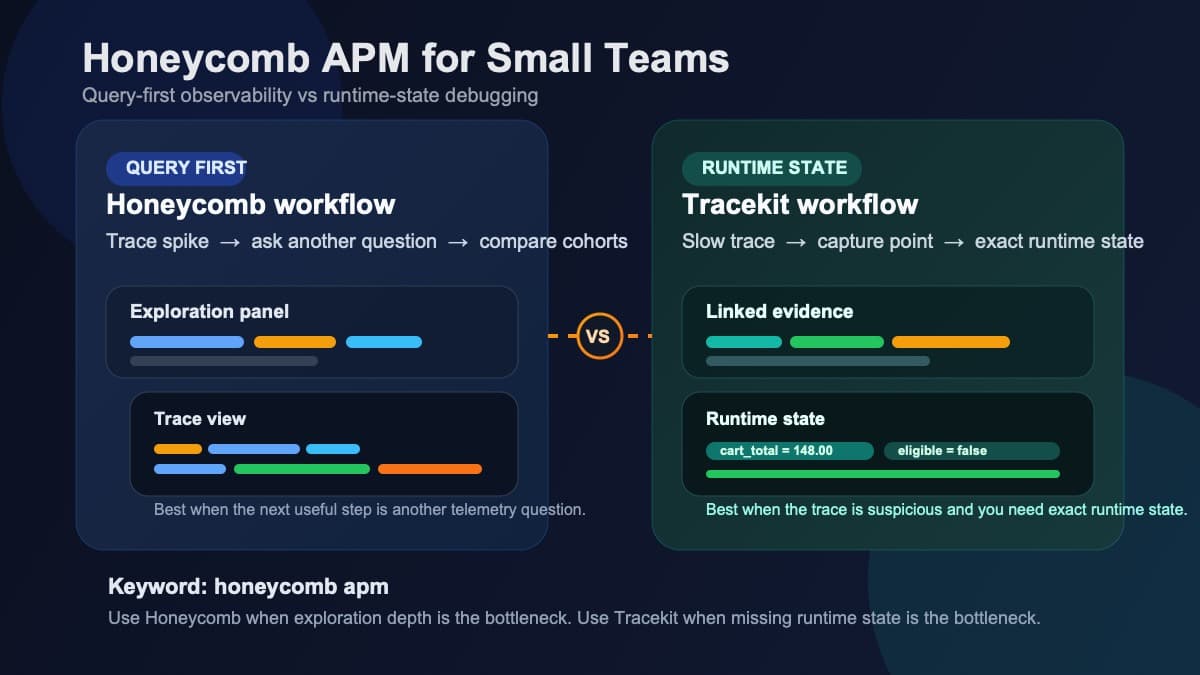
Honeycomb APM for Small Teams: Querying vs Runtime State
Honeycomb APM explained for small teams: query-first observability, pricing tradeoffs, and when you still need runtime state to debug production.