
TraceKit vs Datadog: Same Traces, 80% Less ($29/mo vs $200+)
Cut your Datadog bill by 80%. Real migration story: $4,800 to $950/month with side-by-side feature comparison and step-by-step migration guide.
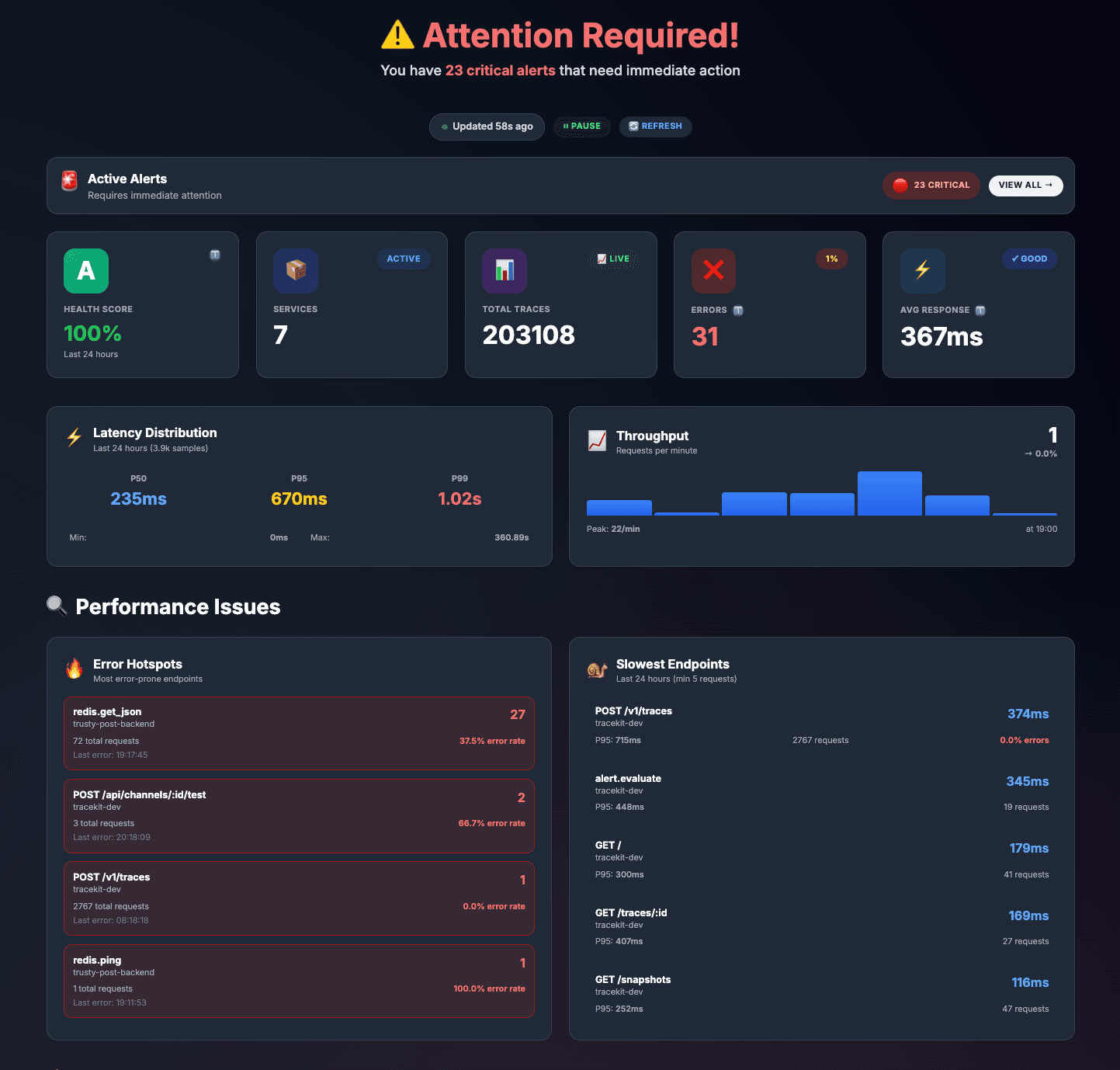
Reduce Datadog bill by 80% without sacrificing visibility -it’s possible, and we did it. When we launched our SaaS platform, Datadog seemed like the obvious choice. Three months later, our Datadog bill hit $4,800/month for just 6 services. This case study shows exactly how we cut costs from $4,800 to $950/month while actually improving our debugging workflow.
Table of Contents
The Breaking Point: Our $4,800 Datadog Bill
Let’s break down where the costs came from:
-
APM (15 hosts): $2,400/month ($31/host/month × 15)
-
Log Management (200GB): $1,200/month
-
Custom Metrics (500 metrics): $750/month
-
Infrastructure Monitoring: $300/month
-
Synthetic Monitoring: $150/month
We were a 5-person startup spending nearly $60,000/year on observability. That’s one engineer’s salary.
The Hidden Costs of Datadog
Beyond the base pricing, Datadog has several cost traps:
1. Host-Based Pricing Penalties
Scaling horizontally? Each new host adds $31/month to your APM bill. If you spin up containers dynamically, costs spiral quickly.
2. Custom Metrics Charges
Want to track business metrics (revenue, signups, feature usage)? Each custom metric costs $0.05/hour. 100 custom metrics = $3,600/year.
3. Log Retention Costs
Datadog charges per GB ingested and per GB stored. Keeping logs for compliance? The bill adds up fast.
4. “Overage” Anxiety
The worst part? You never know what your bill will be until the end of the month. Traffic spike? Surprise $2,000 bill. Check Datadog’s pricing page to see how complex their pricing model is.
Evaluating Alternatives
We evaluated several Datadog alternatives:
| Option | Pros | Cons |
|---|---|---|
| Self-hosted Jaeger/Grafana | Free software | Requires dedicated engineers, ops overhead |
| New Relic | Similar features | Similar pricing structure, still expensive |
| Honeycomb | Powerful querying | Expensive at scale, complex interface |
| TraceKit | Request-based pricing, no surprises | Newer player (but proven OpenTelemetry) |
We chose TraceKit because the pricing model aligned with our usage, not our infrastructure. All options use OpenTelemetry, the industry standard for observability. For a detailed feature-by-feature breakdown, see our TraceKit vs Datadog comparison. You can also compare all APM tools side-by-side.
The Migration: Easier Than Expected
We thought migrating would take weeks. It took 3 hours.
Step 1: Replace Datadog Agent (30 minutes)
Removed Datadog agents, installed TraceKit’s OpenTelemetry SDK:
// Node.js example
// Before: Datadog
const tracer = require('dd-trace').init({
  service: 'my-api',
  hostname: 'datadog.agent',
});

// After: TraceKit (OpenTelemetry)
const { TraceKit } = require('@tracekit/node');

TraceKit.init({
  apiKey: process.env.TRACEKIT_KEY,
  serviceName: 'my-api',
});
Step 2: Update Docker Compose (15 minutes)
Removed Datadog sidecar containers, added TraceKit environment variables:
# Before: Datadog sidecar in every service
services:
  api:
    environment:
      DD_AGENT_HOST: datadog-agent
  datadog-agent:
    image: datadog/agent
    environment:
      DD_API_KEY: ${DD_API_KEY}

# After: TraceKit (no sidecar needed)
services:
  api:
    environment:
      TRACEKIT_API_KEY: ${TRACEKIT_KEY}
Step 3: Verify Traces (2 hours)
Deployed to staging, verified traces were appearing correctly, tested error tracking, confirmed performance metrics matched.
Step 4: Deploy to Production (15 minutes)
Blue-green deployment to production. No downtime. Traces flowing immediately.
The Results: $4,800 → $950/month
Our new TraceKit bill:
-
Growth Plan: $950/month
-
Covers: 10M requests/month (our actual usage)
-
Includes: All traces, all metrics, unlimited services, unlimited team members
-
No overages: If we exceed 10M requests, we just upgrade to the next tier
Savings: $3,850/month = $46,200/year
What We Gained (Beyond Cost Savings)
1. Predictable Pricing
We know exactly what we’ll pay each month. No anxiety about traffic spikes or adding hosts.
2. Faster Debugging
Datadog’s UI is cluttered with features we never used. TraceKit’s interface is focused on debugging – click a trace, see the issue, fix it.
3. Better Trace Context
TraceKit’s AI-powered insights automatically highlight issues in traces (N+1 queries, slow external APIs, error patterns). We find issues faster.
4. No More “Host Tetris”
We used to play games to minimize Datadog hosts (combining services, avoiding scaling). Now we architect for performance, not for billing.
5. Simplified Stack
Removed Datadog agents, sidecars, and forwarders. Our infrastructure is simpler and easier to maintain.
What We Lost (Honest Assessment)
To be fair, here’s what Datadog had that we gave up:
Infrastructure Monitoring
Datadog tracks CPU, memory, disk per host. We moved this to AWS CloudWatch (native, cheaper for AWS infrastructure).
Log Management
Datadog indexes all logs. We moved to ELK stack for long-term log storage and use TraceKit for trace-to-log correlation.
Synthetic Monitoring
Datadog’s synthetic tests are nice but expensive. We moved to UptimeRobot ($10/month) for uptime monitoring.
Bottom line: We unbundled Datadog’s features and picked best-in-class tools for each use case.
Who Should Consider Switching?
If you’re looking to reduce your Datadog bill significantly, switching makes sense if:
-
Your Datadog bill is >$2,000/month
-
You primarily use APM/tracing (not infrastructure monitoring)
-
You’re scaling horizontally (adding hosts/containers)
-
You want predictable pricing
-
You value simplicity over feature sprawl
Datadog still makes sense if you need a single tool for everything (infrastructure, logs, APM, security, network monitoring). But for most teams, that’s overkill.
The Migration Checklist
If you’re considering switching to reduce your Datadog bill, here’s our recommended approach:
Week 1: Evaluation
-
Sign up for TraceKit free trial
-
Instrument one service in staging
-
Compare traces side-by-side with Datadog
-
Calculate cost savings based on your usage
Week 2: Staging Migration
-
Migrate all services in staging environment
-
Update dashboards and alerts
-
Train team on new UI
-
Test error tracking and performance monitoring
Week 3: Production Migration
-
Deploy to production with blue-green deployment
-
Run both Datadog and TraceKit in parallel for 1 week
-
Verify all traces are captured correctly
-
Cancel Datadog subscription
Frequently Asked Questions (FAQ)
How can I reduce my Datadog bill?
To reduce your Datadog bill, you can: 1) Switch to a more cost-effective APM alternative with request-based pricing instead of host-based pricing, 2) Reduce custom metrics by eliminating unused metrics, 3) Decrease log retention periods, 4) Use sampling for traces instead of 100% capture, or 5) Scale down to fewer hosts by consolidating services. Moving to an alternative like TraceKit can reduce costs by 60-80%.
What are the best Datadog alternatives?
The best Datadog alternatives include TraceKit (request-based pricing, OpenTelemetry standard), New Relic (similar features but similar pricing), Honeycomb (powerful querying but expensive at scale), Grafana Cloud (good for self-hosted option), and self-hosted solutions like Jaeger + Grafana. Choose based on your budget, team size, and required features.
Is it hard to migrate from Datadog?
No, migrating from Datadog is relatively easy, especially with OpenTelemetry-based alternatives. Most migrations can be completed in 1-3 weeks. The process involves: replacing Datadog agents with new SDKs, updating environment variables, testing in staging, and deploying to production. Our migration took just 3 hours of actual work spread over 2 weeks of testing.
Why is Datadog so expensive?
Datadog is expensive because of its host-based pricing model ($31/host/month for APM), custom metrics charges ($0.05/hour per metric), log ingestion and retention costs, and because it’s an all-in-one platform bundling features you may not need. Costs scale linearly with infrastructure, making it prohibitively expensive for startups and scale-ups. The pricing model favors large enterprises over growing companies.
How much can I save by switching from Datadog?
Cost savings depend on your usage, but most teams save 60-80% by switching from Datadog to alternatives with request-based pricing. For example, we reduced costs from $4,800/month to $950/month (80% savings = $46,200/year). Teams with 10+ hosts typically see the most significant savings because host-based pricing scales poorly compared to request-based pricing.
Final Thoughts
Switching observability tools sounds scary. We thought it would be a nightmare. But with OpenTelemetry as the standard, migration was smooth.
The $46,000/year savings let us hire another engineer. The simpler architecture reduced operational overhead. The predictable pricing eliminated invoice anxiety.
If you’re frustrated with Datadog’s pricing, you’re not alone. There are better options.
Ready to reduce your observability costs? Start a free 7-day trial and see your actual savings. Follow our step-by-step Datadog migration guide to get started. No credit card required until trial ends.
“`
Related Posts
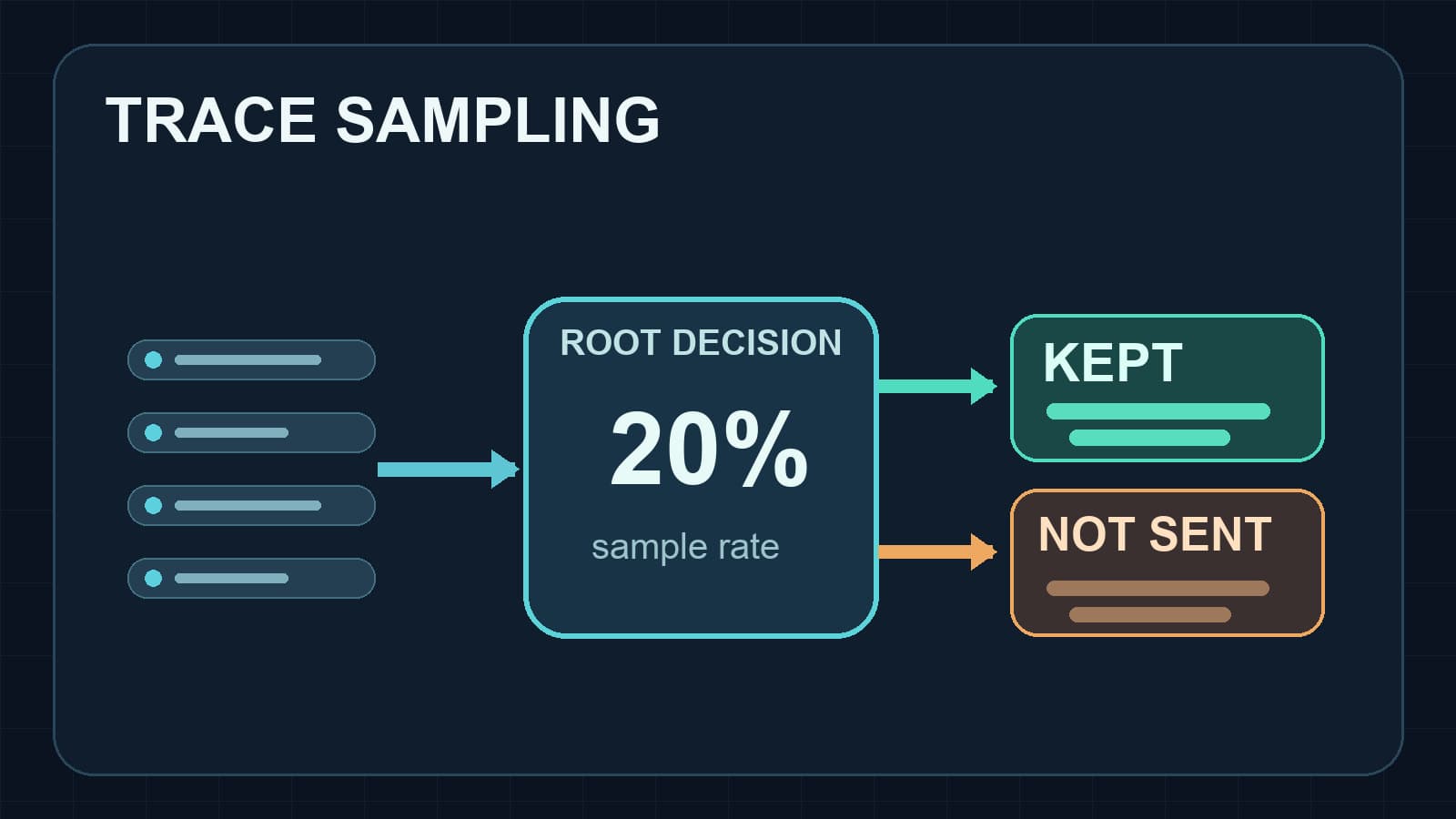
DD_TRACE_SAMPLE_RATE in Node.js: A Practical Guide
Set DD_TRACE_SAMPLE_RATE in Node.js, understand rate limits and sampling rules, and verify which distributed traces reach Datadog.

Best Datadog Alternatives Under $50/Month (2026)
5 Datadog alternatives under $50/month for startups. Compare TraceKit, Highlight.io, HyperDX, OpenObserve, and SigNoz on features, pricing, and setup.
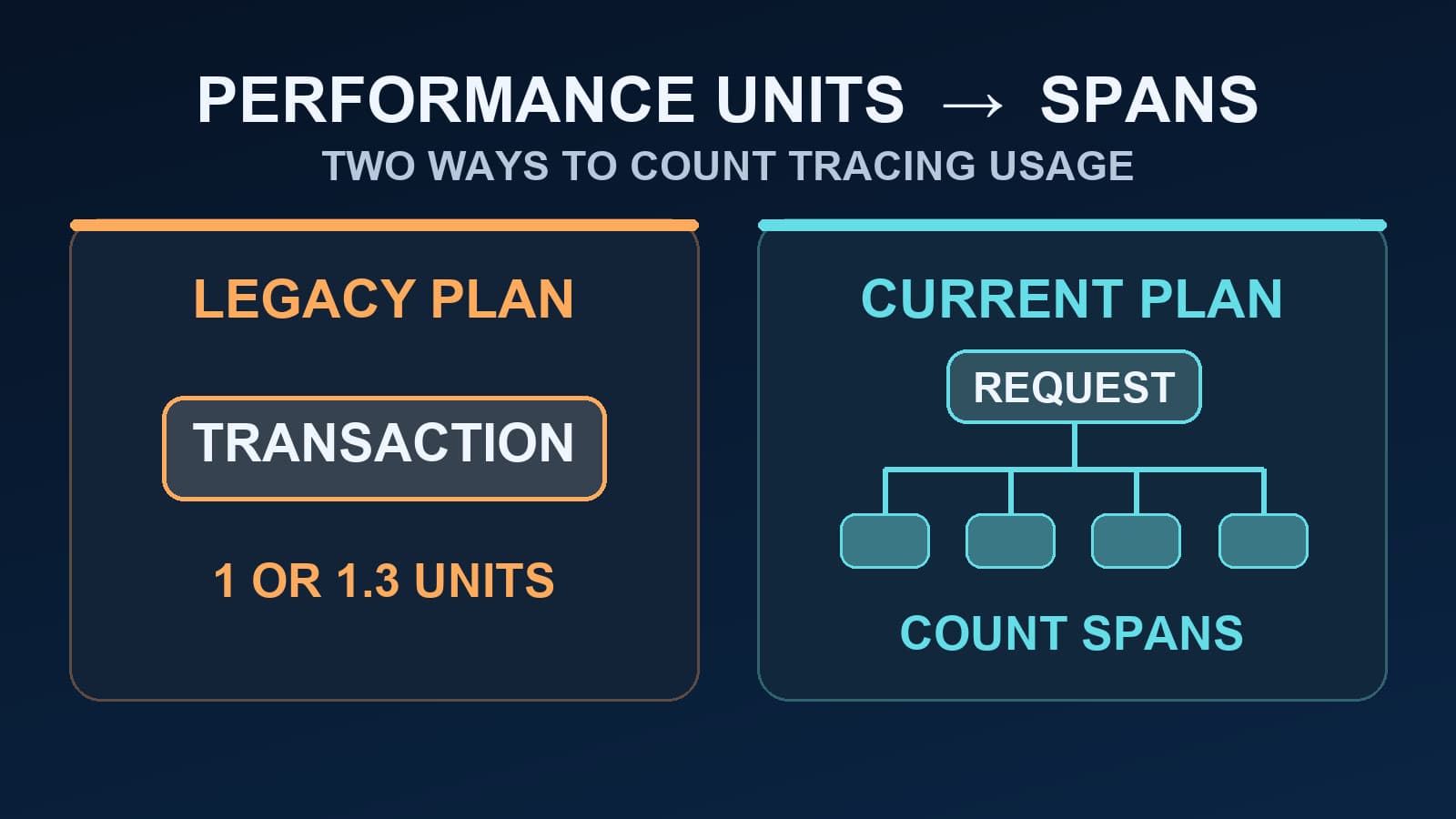
Sentry Performance Units vs Spans: What Changed?
Learn when Sentry performance units still apply, how legacy transactions were counted, and why current span quotas need a different estimate.